
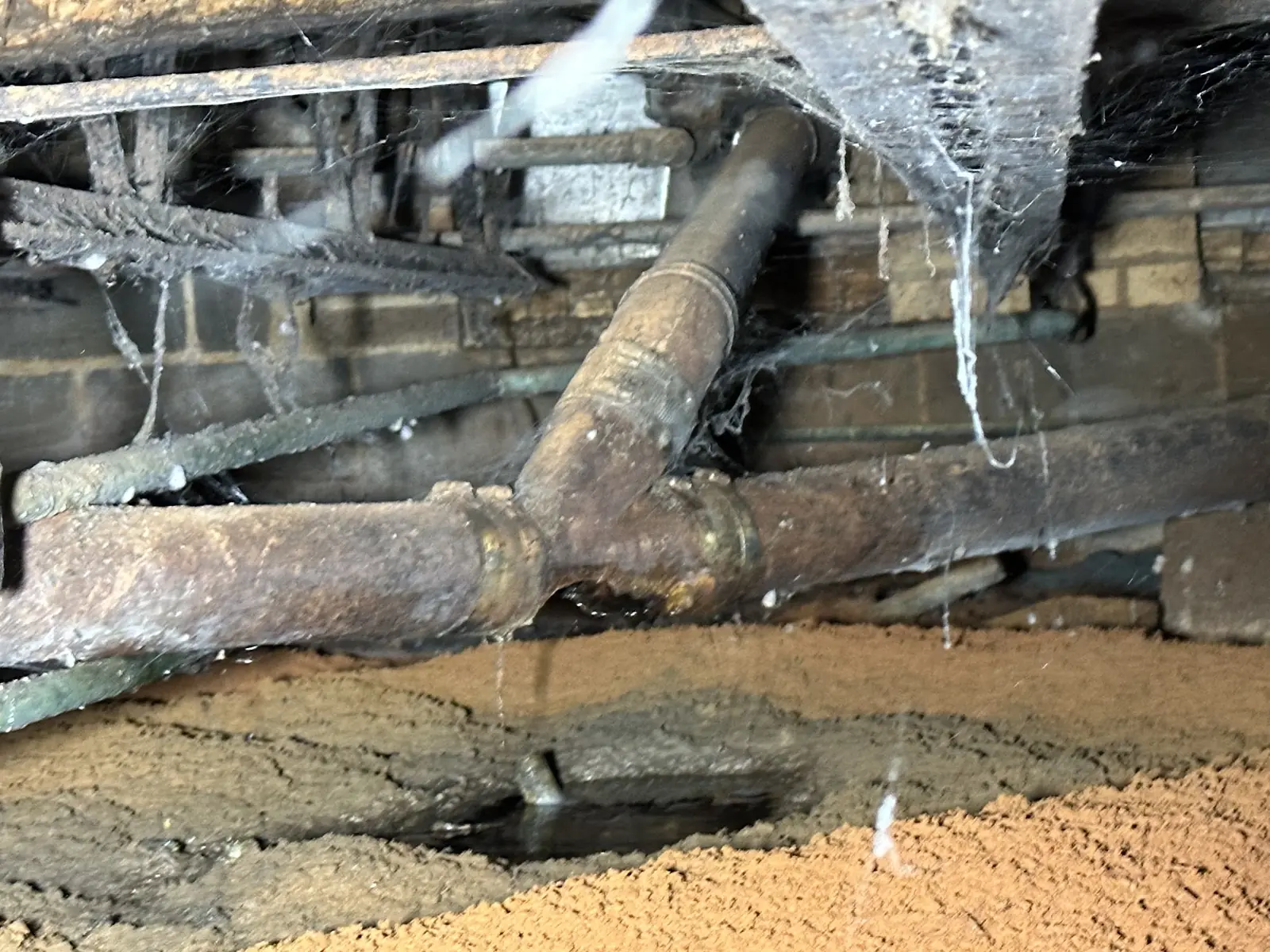
Why Charlotte's tree roots and red clay are hard on sewer lines
Short answer. Trees cover nearly half of Charlotte, and their roots follow moisture into any gap in a sewer pipe joint. The Piedmont's dense clay subsoil drains slowly, and some of it shrinks and swells as it dries and wets, which strains rigid pipe at the joints. Older clay, Orangeburg and cast iron lines are the most exposed to both.
Two things define a Charlotte yard: big trees and red dirt. Both have a say in how long a sewer line lasts. Neither is a reason to panic or to cut down an oak. They are reasons to know what your line is made of and what shape it is in.
How much of Charlotte is covered by trees?
A study by the city and the nonprofit TreesCharlotte put the tree canopy at 47.3 percent of Charlotte's land area in 2022, down slightly from 47.8 percent in 2018. Close to half the city sits under leaves.
The age of those trees matters as much as the number. According to the UNC Charlotte Urban Institute, many of the city's largest trees were planted between 1895 and 1920, and willow oaks dominate neighborhoods like Myers Park. In older neighborhoods, the roots of those trees can share the ground with sewer pipe from the same decades.
How do tree roots get into a sewer line?
Roots do not break into a sound pipe. They find one that is already leaking a little. One municipal sewer department describes it this way: roots are attracted to the water vapor leaving the pipe, follow that vapor trail to its source, and push through a crack or loose joint to reach the moisture and nutrients inside.
Once a hair-thin root is in, it has what it needs. It thickens and branches, catching paper and grease until the line slows and then stops. Cutting the roots restores flow but leaves the gap, so they grow back.
The pipe material decides how easy the way in is.
- Clay is the most vulnerable. It is brittle, it cracks, and its joints are where roots enter.
- Orangeburg, a tar-impregnated fiber pipe used from about 1948 into the 1970s, was joined with plain compression couplings and deforms over time. Roots get in easily, and mechanical root cutting can tear pieces out of the pipe.
- Cast iron rusts from the inside. Once the bottom of the pipe wears through, roots have an opening.
- PVC has fewer joints, and when they are glued properly they are watertight and closed to roots. A PVC line that has cracked or pulled apart is exposed like any other.
Dry weather raises the stakes. The same sewer department notes that during drought and in winter, tree roots travel long distances in search of moisture. In a dry Charlotte summer, a weeping sewer joint can be the wettest spot in the yard.
What does red clay soil do to sewer pipes?
Start with what the soil is. NC State Extension notes that much of the subsoil in the Piedmont has a high clay content, and that soils high in clay move water slowly and can stay wet for long periods. The red clay most people picture is the Cecil soil series. The USDA describes it as a well drained soil with a red clay subsoil, found across the Piedmont from Virginia to Alabama.
Here is a detail that often gets lost. Piedmont clays do not all behave the same way. The USDA rates Cecil's shrink-swell potential as low. The Piedmont also has soils formed from darker rock, rich in iron and magnesium, that move a good deal more. The Mecklenburg series, first described in Mecklenburg County in 1910, has a sticky, plastic clay subsoil rated moderate for shrink-swell. The Iredell series, named for the county just north of Charlotte, is rated very high in its subsoil and drains very slowly. Which one is under your yard depends on your street.
For a buried sewer line, clay matters in three ways.
- It holds water. Slow-draining clay keeps the soil around a leaking joint wet, and moisture is the signal roots follow.
- It can move. Where the clay is the shrink-swell kind, it swells as it wets and shrinks as it dries. Rigid pipe laid in sections can take that movement at its joints, and a joint that shifts is a joint that opens.
- It punishes a leak. Water escaping from a failing pipe can wash out the soil beneath it. The pipe then sags into a low spot, called a belly, that holds water and solids.
None of this means a sewer line in clay is doomed. It means that small defects tend to grow, and that roots are quick to find them.
What are the warning signs of roots in a sewer line?
- Drains that slow down again a few months after being cleared
- Gurgling from a toilet or tub when another fixture drains
- More than one fixture backing up at once, which points to the main line
- A strip of lawn that is greener, wetter or lower than the rest, running toward the street
- Sewage odor outside or in the crawlspace
- Root fibers on the cable when a drain is cleaned
None of these proves the pipe is broken. Each one is a reason to stop guessing. A sewer camera inspection shows the pipe material, where roots are coming in, and whether the pipe has shifted or sagged.
What can you do about roots and shifting soil?
You cannot change the soil, and you should think twice before removing a healthy tree. What you can do is manage the pipe.
- Find out what you have. One camera inspection tells you the material and condition of the line. Keep the video.
- Clear roots the right way. A cable machine cuts roots and gets the line flowing. Hydro jetting removes smaller roots and the debris they trap, provided the pipe is sound enough for it. Both are maintenance, because the gap is still there.
- Clean on a schedule if the pipe is sound. A line with light root growth at a joint or two can often stay in service with regular cleaning. How often depends on how fast the roots return.
- Close the gaps. When roots come back quickly, or the camera shows a cracked or offset section, replacing that section with modern pipe removes the way in. A sewer line repair can be limited to the part that failed if the rest of the line is sound.
- Plant with the line in mind. Before you plant a new tree, find the path of your sewer line and keep large species away from it.
- Watch what goes down the drain. Wipes and grease catch on roots and turn a partial blockage into a full one.
Roots are a symptom. The cause is an opening in the pipe. Clearing roots buys time, and closing the opening solves the problem.
Alpha Drain clears and inspects sewer lines across Charlotte at any hour. Spyro has 15 years of experience with drain and sewer pipe, and he will tell you plainly whether your line needs cleaning, a repair or nothing at all. If a drain keeps clogging, call (980) 408-1705. We will start with drain cleaning or a camera, whichever the history calls for.
More questions
Usually not as a first step. Removing a mature tree is expensive, and you should check local tree rules before taking one down. The roots found a leak. Repair the damaged section of pipe and the tree and the sewer line can share the yard.
It varies with the tree, the season and the size of the opening, so there is no reliable number. Some lines stay clear for years and others slow down again within months. A follow-up camera inspection shows how quickly roots are returning and whether a repair makes more sense than repeat cleaning.
Charlotte Water maintains the public sewer mains under the streets. As a rule of thumb, it says the homeowner's responsibility for the sewer line starts at the street right-of-way, with possible exceptions. Roots in the line on the house side of that point are the owner's to deal with.
Less so. PVC has fewer joints, and its glued joints are watertight when done properly. It can still be crushed, pulled apart or left with a low spot if the ground under it settles. If a newer line starts to clog, a camera check is still worth doing.
Related services
Written by the Alpha Drain team in Charlotte, NC. Alpha Drain is a licensed and insured plumbing company run by Spyro Vassiliou, a plumber with 15 years of experience. This article is general information, not a substitute for an on-site diagnosis.
Plumbing in Charlotte, backed in writing
1-Year LaborWarranty
Covers labor on repairs and installations. Drain cleaning is excluded.
Get Your Plumbing Fixed In Just Three Easy Steps
An Easy Call
Call, text, or send the quote form. Tell us what is happening and we will tell you when we can be there, often the same day.
Step 1Choose Your Fix
We find the cause, show you what we see, and walk you through your options and the price before any work starts.
Step 2Problem Solved
We do the repair, test it, clean up, and file any paperwork. Labor on repairs and installations is covered for a year.
Step 3
Ready To Get Your Plumbing Fixed?
Open 24 hours. Licensed & insured. 1-year labor warranty.